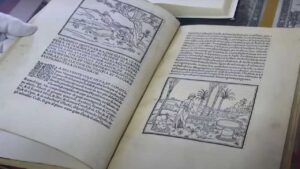
The “Hypnerotomachia Poliphili” or the love dream fight of Poliphilo. What at first sight may seem almost like a tongue twister actually represents a great heritage not only of Italian literature but above all a very valuable work of typographical art from the 16th century (1499, to be precise): the incunabula. In Galatina, in Puglia, together with a very rare copy of the Hypnerotomachia Poliphili, there are as many as 140 incunabula (the first books printed in typography): an extraordinary collection of evidence that attests to how in these places people once studied in Greek, in Latin, Hebrew, Aramaic. Here, despite the conflicts between civilisations, Christians, Jews and Muslims discussed philosophy, mathematics, astronomy and poetry, in Galatina ancient texts were copied and sent to all parts of the world. I spoke about it with Luca Carbone, a very passionate scholar from Salento who, before the interview, proudly reiterated that “Galatina was once the navel of the world, and the places where these texts were studied were the navel of the navel of the world”. In Galatina, in Salento, in the heart of Southern Italy. “South! Vostok100k along the South Cultural Routes” was a journey traveled aboard the Vostok100k (www.vostok100k.com), the old 1982 camper of Lorenzo Scaraggi, journalist, reporter. Lorenzo Scaraggi crossed Puglia, Molise, Campania, Basilicata and Calabria in search of anthropological, ethnographic, historical stories, traditions and all those intangible cultural assets of which the south is rich. South Cultural Routes is an excellent project of MIBACT in collaboration with the Puglia Region, Molise Region, Basilicata Region, Calabria Region and Campania Region.

Fuori Rotta Italia
 The recipe for Bitonto’s Cartellate. From Puglia Fuorirotta trip